IN THIS ARTICLE:
it started with cream
does papalina matter?
strasciati - carbonara - papalina
recipe
IT STARTED WITH CREAM
During the Covid Pandemic I began researching the thorny problem of cream in Carbonara - where had it come from, how did it grow in popularity, and so on. I’d heard about the story of Fettuccine alla Papalina, the dish supposedly invented for Cardinal Eugenio Pacelli, who would become Pope Pius XII in 1939 - and wondered if later confusion with that dish could have contributed to the tradition that emerged, from the 1950s onwards, of adding cream to Carbonara.
As I researched Papalina, an anecdote kept surfacing: that Cardinal Pacelli, reputedly troubled by a sensitive stomach, had once asked a Roman restaurateur to prepare a special dish for him. The resulting dish, according to these accounts, was a more ‘refined’ version of Carbonara: fettuccine in a sauce with cream, eggs, pecorino, onion and prosciutto crudo.
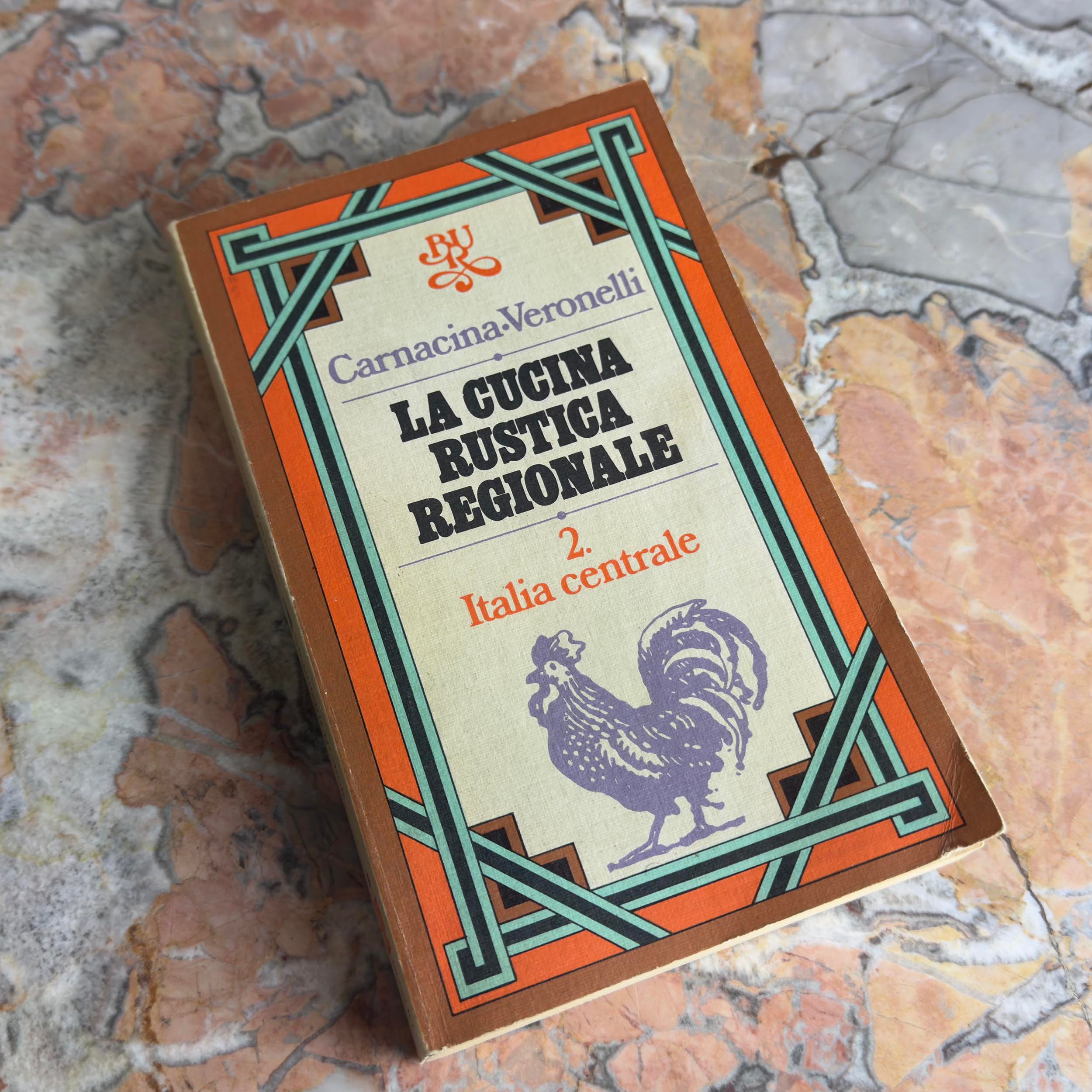
And that’s when the plot thickens - some food historians have dated Pacelli’s request to the early 1950s, when Carbonara was THE pasta dish taking pockets of Rome by storm, presumably also influenced by the dish’s name - you’d have to be a pope, after all, to have a dishes named ‘papalina’ in your honour… Others, on the other hand, including the account in Carnacina & Veronelli’s ‘La Cucina Rustica Regional’ book, which landed on my doorstep this morning, maintain that Pacelli’s request to Cesare Simmi, the proprietor of La Cisterna restaurant, happened some time in the 1930s, and the dish went on to acquire its ‘papalina’ name once Cardinal had become Pope.
I’ve recently corresponded with the current owners of La Cisterna restaurant, who have told me that the Simmi family had confirmed Pacelli was a regular there in the 1930s. They also believe it was then that he asked Simmi to prepare the pasta that would become Papalina.
This version of events is also echoed by Oretta Zanini De Vita in Popes, Peasants, and Shepherds (2013), where she describes Papalina as a variant of Carbonara prepared for Pacelli while he was still a cardinal, and renamed after his election. Frank Fariello tells a similar story in his Memorie di Angelina article dated July 2009 - and explicitly calls out the elephant in the room: how could a dish created before 1939 have been adapted from something supposedly invented during the war?
DOES PAPALINA MATTER?
Even more than the previous observation… because for Chef Cesare Simmi to devise a dish based on a Carbonara, Carbonara would of course have had to be an already established recipe, or at least known in restaurant circles at the time. And that potentially pushes Carbonara’s possible first creation date back several years.
Reading this possible chain of events together with the recently discovered 1939 article by Nora Berkhuijsen gives us an intriguing possibility - Carbonara may have been an established and well known recipe in the Trastevere quarter of Rome earlier than the mid-1930s.
IS CARBONARA UMBRIAN?
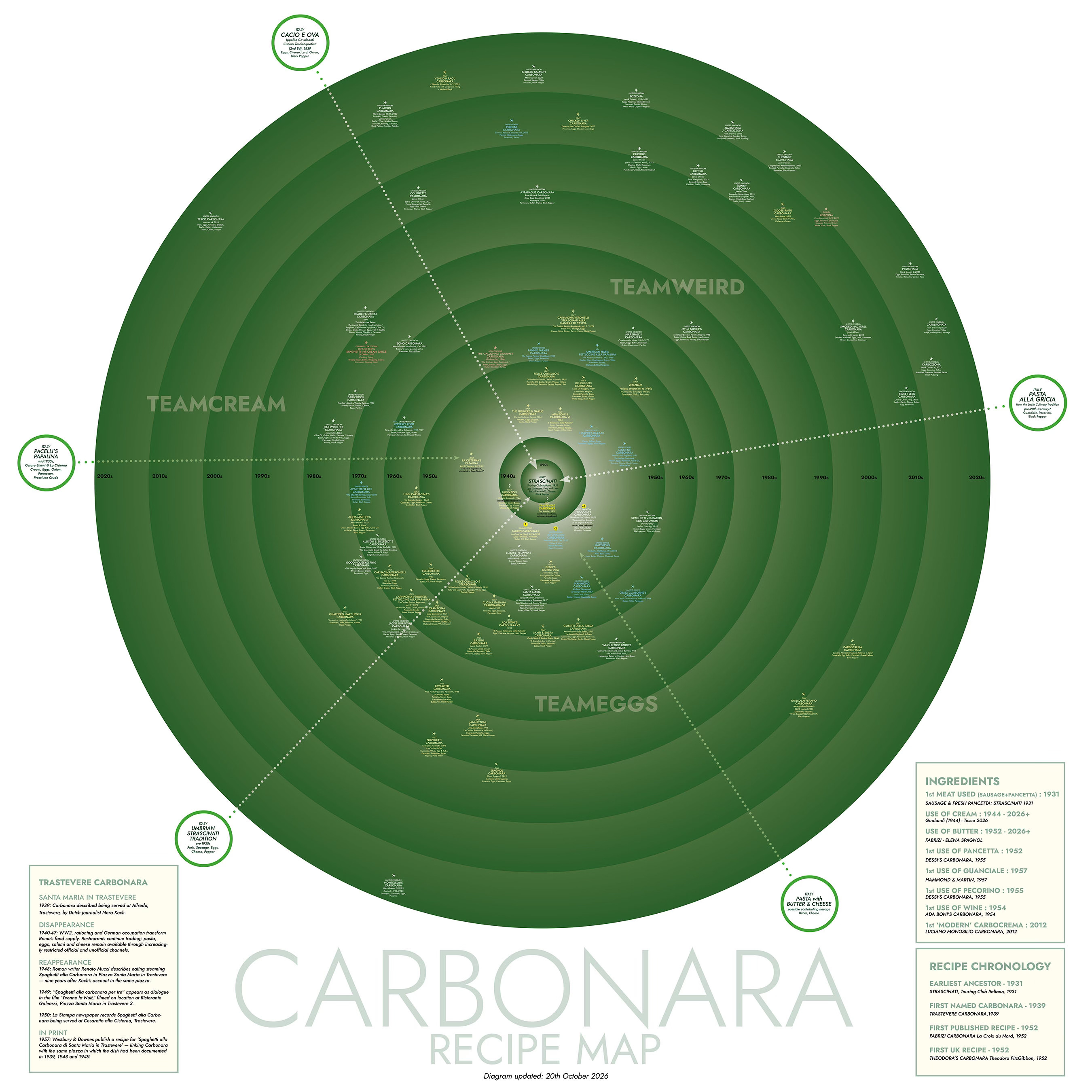
I’d be betraying my inner pasta detective if I didn’t also mention the Strascinati you may remember from the Touring Club Italiano’s 1931 listing (see the Recipe Map, above). Given the huge similarity in ingredients, if we consider that dish to be an ancestor of Spaghetti alla Carbonara, we could be remarkably close to being able to pinpoint the window during which Strascinati evolved into Spaghetti alla Carbonara and found its way from the Umbrian hills to Trastevere in Rome.
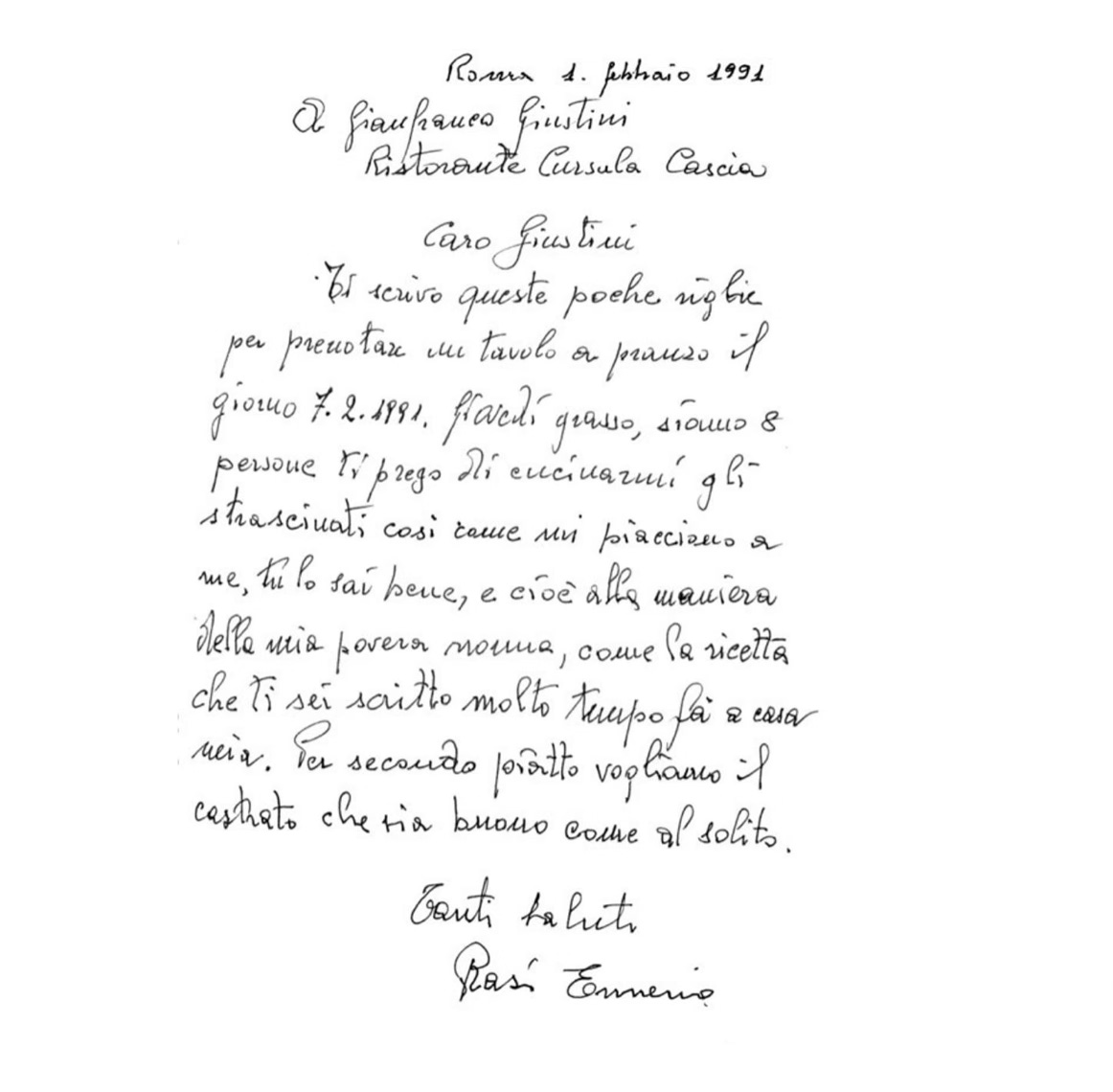
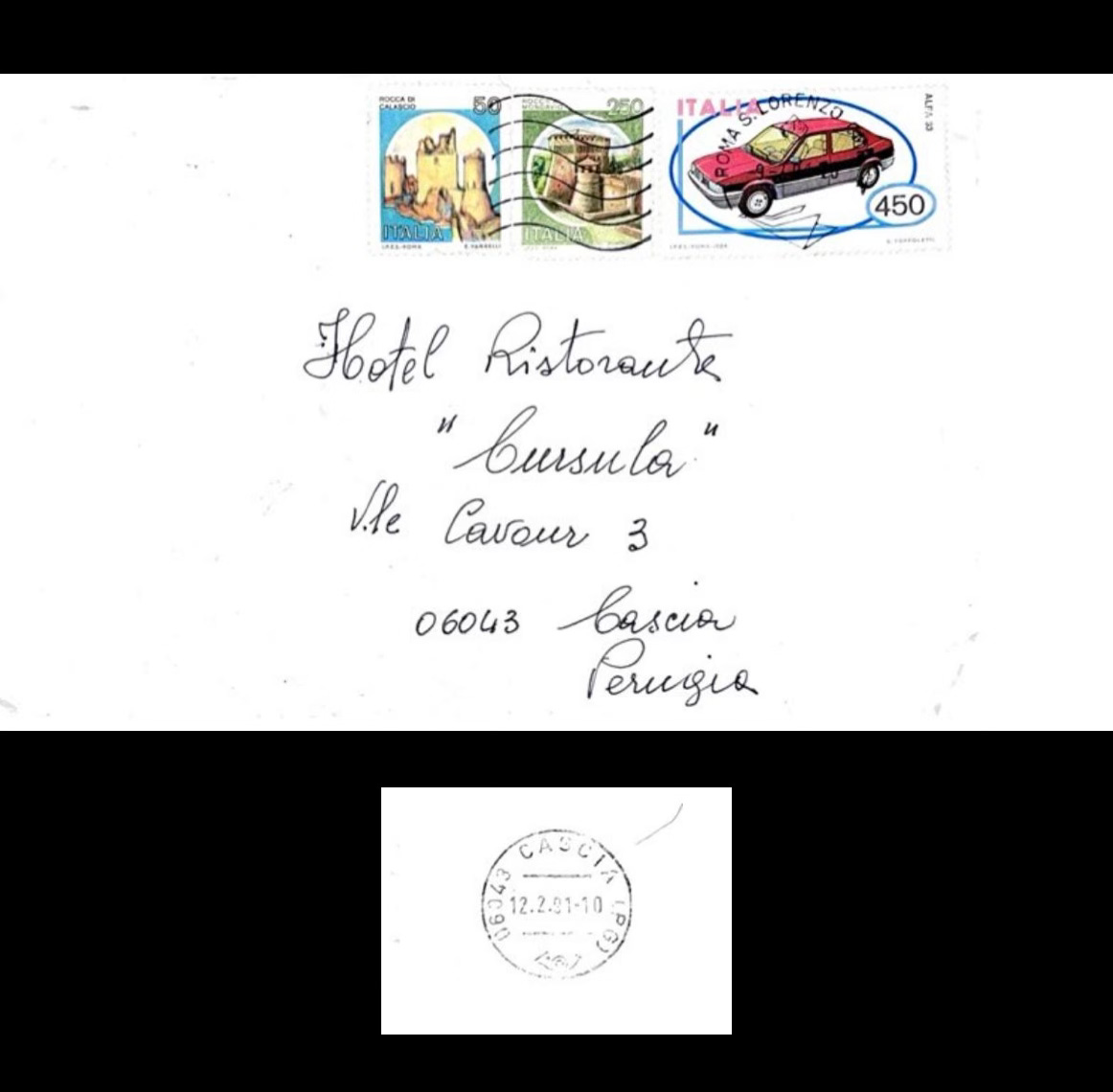
I was recently sent some fascinating evidence from the owners of Locanda Giustini in Assisi: a letter from a regular diner at a restaurant they previously managed.
The letter is a request to make a booking at the restaurant, and the writer (aged in his 90s in 1991) asks the owners to cook their signature dish – and also his favourite dish – of STRASCINATI, just like his own Nonna used to make.
Of course, if Sig. Rasi was in his 90s in 1991, his memories of his grandmother cooking strascinati could date from any time between c. 1896 and the late 1910s!
Look back at the Recipe Map – before 1896, we have three possible recipe ‘lineages’ that I’ve linked to Carbonara: Cavalcanti’s Cacio e Ova (1839), Pasta alla Gricia (possibly pre-20th century) and Pasta with Butter and Cheese (much older, probably pre-Renaissance).
All of those potential ‘contributing’ recipe lineages fit perfectly with a possible first creation date for Umbrian Strascinati in the latter half of the 19th century.
And of course, as I’ve mentioned before in other articles, it would be quite possible for a recipe to emerge independently of any other recipe listed on the diagram.
STRASCINATI-CARBONARA-PAPALINA : COULD THIS HAVE HAPPENED?
Based on this recent evidence, I think it’s certainly plausible that a version of what became known as ‘Carbonara’ might have reached Rome via an older Umbrian recipe tradition by the 1920s. It might have been very similar to the 1931 Touring Club recipe, or it may have already been slightly adapted – with strascinati making way for Roman long pasta shapes, including spaghetti. By the 1930s, newly rechristened to echo its rural roots and perhaps also link to the signature spice in the dish, Carbonara becomes embedded in the local restaurant circuit in Trastevere.
At some point in the 1930s, Cardinal Pacelli makes his famous request for a more ‘refined’ Carbonara to Chef Cesare Simmi. Papalina is born but remains an obscure, unpublished recipe, featuring in only one media mention until the late 1960s – a RAI TV feature on 20th July 1955. In the clip, Papalina is described as a ‘speciality’ of La Cisterna restaurant, but no ingredients are given and the commentary links the dish to Pope Sixtus V!
In 1968 we find the earliest published recipe I’ve located so far for Papalina. American Home’s October issue carries a recipe for spaghetti in a sauce of cooked ham, mushrooms, onions, yolks, parmesan and parsley – and – 8 tablespoons of butter or margarine.
From the mid-1950s onwards, Carbonara of course overshadowed both Strascinati and Papalina as it began its journey towards the piggy custard fest adored by today’s social media… but I wonder… were the myriad cream-based Carbonaras in the 70s and 80s influenced by the Pope with the sensitive stomach who ended up being served a cream, cheese and egg pasta?
Dante would have called that a ‘contrapasso’ – the punishment we receive in the afterlife turning out to be fitting retribution for our earthly sins.
Me? I just think sometimes life can be funny like that.
Recipe
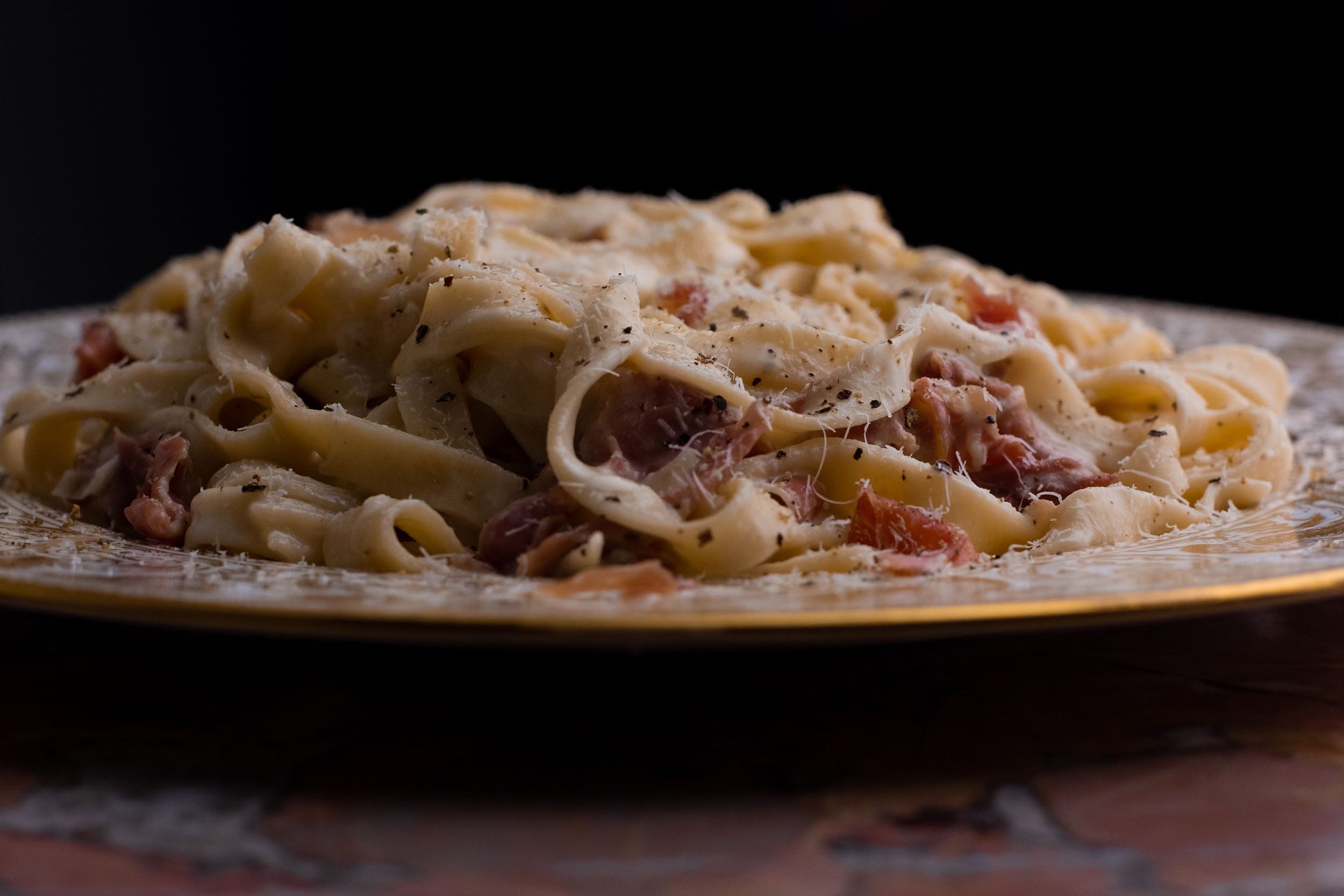
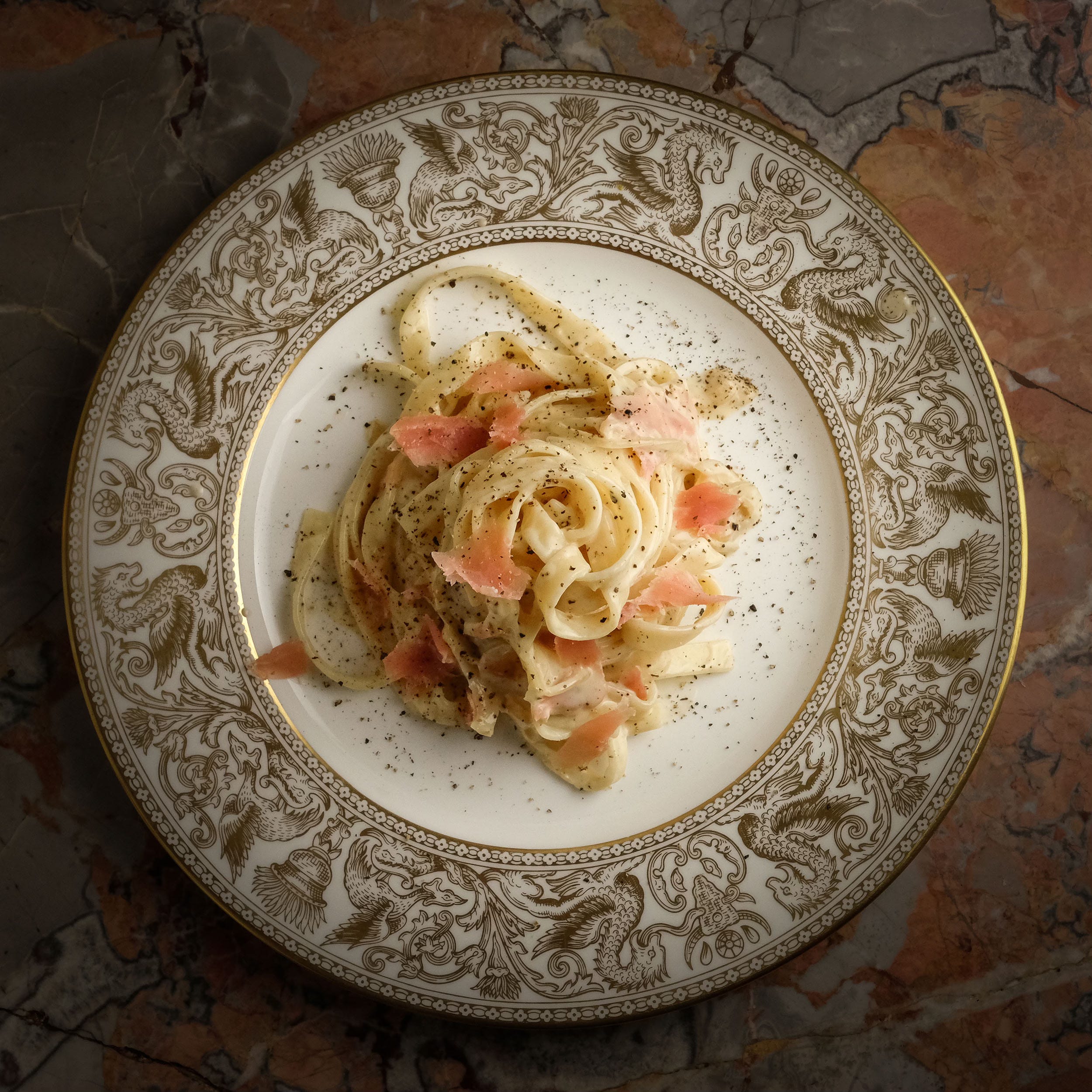
The first time I recreated Papalina I followed what seems to have been the ‘classic’ version (above) - frying the prosciutto crudo in butter before incorporating it into the sauce. More recently, I’ve taken pity on poor Pacelli - and my own liver - and done a variation with uncooked prosciutto, added at the plating stage (below). It’s a taste I prefer and, I think, one more step towards ‘refined’ - I’m pretty sure His Sensitiveness would have approved.