


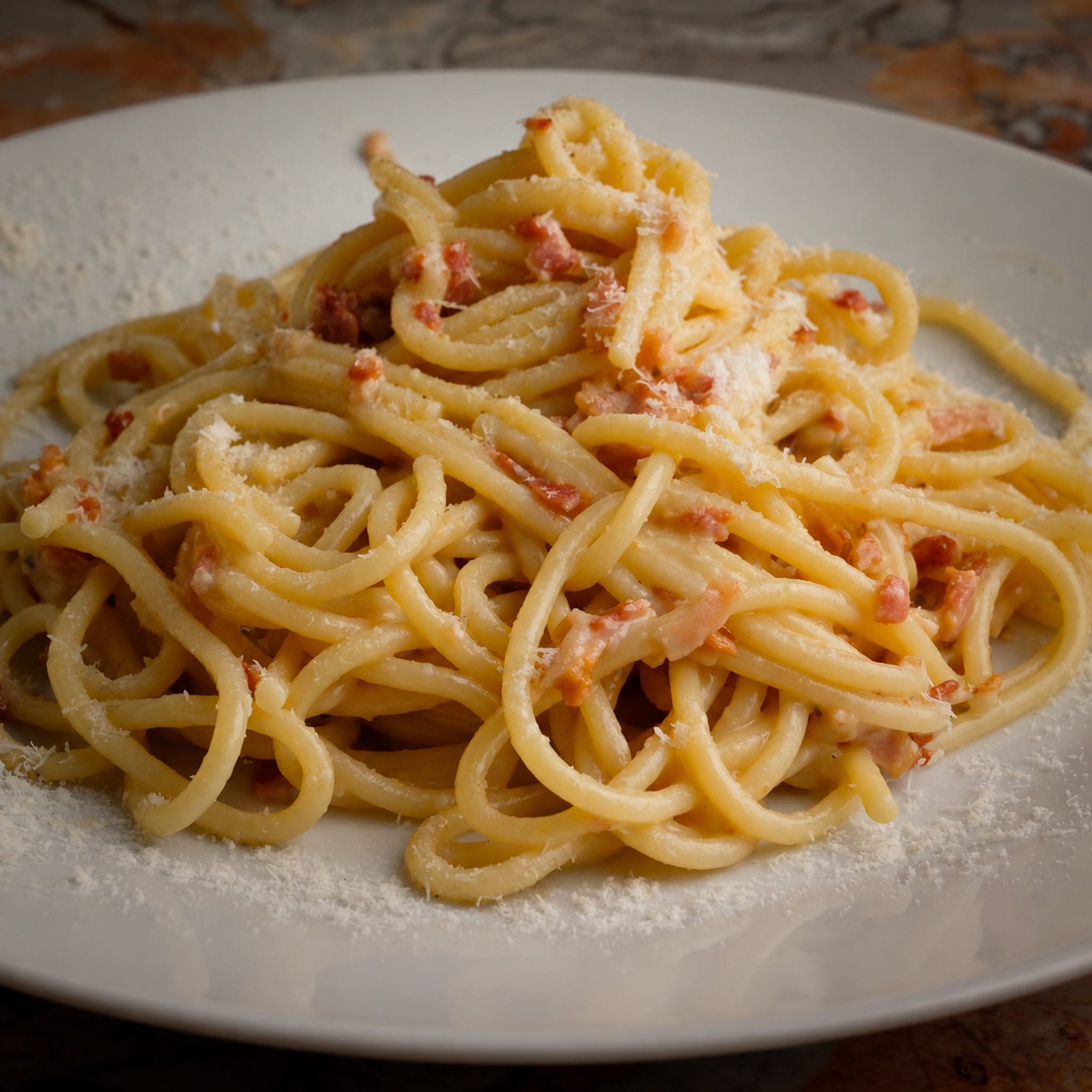
THE BACK STORY - AND THE STRANGE CASE OF THE MISSING BLACK PEPPER
Last week I wrote about the first recipe for Carbonara published in Britain, Theodora FitzGibbon’s Spaghetti Carbonara. Whilst both Elizabeth David and Theodora would have presumably experienced very similar Roman Carbonaras when they were in Rome, I think it’s fascinating to see the different routes they adopted for their own recreations, particularly when it comes to the use of black pepper. Both of these two very early British carbonara recipes actually omit pepper, while the contemporary Cucina Italiana Carbonara (Aug 1954) demands plenty of it!
But before we get into all of that, let’s take a step back and consider what could have shaped these two groundbreaking British pasta recipes.
THE BACK STORY
The first record of Carbonara being served in Rome comes in 1939, from the Dutch-language newspaper De Koerier, which was published in modern-day Jakarta (then the Dutch East Indies). Discovered in 1926 by Dutch food journalists Janneke Vreugdenhil and Edwin Winkels, the article was originally the work of journalist Norah Koch Berkhuijsen, the paper’s Rome correspondent, who wrote a regular column titled "Mensen en dingen uit Rome" ("People and Things from Rome").
Describing food in the Roman quarter of Trastevere, Berkhuijsen’s original article reads:
"...where two trattorias were doing a brisk business. One, Umberto, had shrimp risotto as his specialty, and the other, Alfredo, 'spaghetti alla carbonara', 'strings' like the charcoal burner's wife makes them."
THE FIRST ‘GOLDEN AGE’ IN PASTA HISTORY?
The last phrase above is fascinating. It’s evidence of a link in popular culture from Rome in 1939 between a recipe called “Spaghetti alla Carbonara” and the charcoal producers (‘carbonari’) of the regions surrounding Rome. Quite independently of this article, food historians have indeed suggested that Carbonara owes its name to the black pepper in some early versions of the recipe. It’s been interpreted as a metaphor for the charcoal produced by the ‘carbonari’ - and I think it’s clear that’s what Berkhuijsen is alluding to in her article.
It’s also a highly significant reaffirmation of how popular culture painted the origins of the dish: pepper = coal = a recipe rooted in history.
That’s huge. It could be one of the first instances of the phenomenon of recipes being remembered simply because of manufactured mythology. Made-up stuff. Food historians have described this process as part of a yearning for a ‘golden age;’ and I had always assumed it to be more evident in post-WW2 food writing. To find traces of this tendency of romanticising the past just weeks before the outbreak of the Second World War is both heartwarming and heartbreaking.
