

IN THIS ARTICLE
setting the scene
under the spell
food rationing: the unattainable Carbonara dream
it’s Carbonara, but not as we know it
Theodora the explorer
first impressions
the recipe: how it eats, what it tells us
the very first British Carbonara
is this recipe Carbonara without ‘coal’ ?
the impact of food rationing
setting the scene
UNDER THE SPELL
Something a little momentous was going on in Trastevere, Rome in the late 1940s and early 1950s, but of course no one realised it at the time.
Quite separately and independently, two British authors fell under the spell of one of Rome’s latest recipes - Spaghetti alla Carbonara - and both writers subsequently included it in the cookbooks they were writing. That’s how 1952’s Cosmopolitan Cookery in an English Kitchen (Theodora FitzGibbon) and 1954’s Italian Food (Elizabeth David) came to thrust the eggiest pasta sauce the world had ever seen in front of an incredulous Britain.
That’s a pivotal moment in pasta history…. in social media history. Because without FitzGibbon and David, today the internet would be limping along on kittens, Get-Ready-With-Me, Police Chase and Eyeshadow videos.
Perhaps both authors had indeed been so captivated by Carbonara’s novel ingredients and approach to pasta sauce that they simply felt obliged to introduce the recipe to 1950s Britain.
Their timing, however, couldn’t have been worse.
THE UNATTAINABLE DREAM
Britain in 1952 wasn’t a great time to try and cook pasta, or in fact anything remotely interesting. Wartime food rationing was still in place, and would drag on for a further two years. Whilst some basic foods like bread and flour were slowly becoming more readily available, other staples like sugar, butter and meat (including bacon) remained tightly controlled.
Pasta was mostly known in its tinned form, with early convenience food products like Heinz Spaghetti being already well established for several decades. Olive oil wasn’t even classed as a cooking ingredient, and wouldn’t really be for another couple of decades. If you wanted to buy olive oil in the 1950s, you’d need to visit your neighbourhood chemist, where it was sold as a remedy for earache, sunburn and constipation.
Even worse, dry spaghetti and parmesan were seen as exotic specialities, sold exclusively in high-end city delicatessens or niche, small Italian grocers - in areas like Soho or Clerkenwell in London, the heart of the city’s Italian community.
Yet that’s the reality which FitzGibbon’s and David’s readers would have encountered. Spaghetti alla Carbonara would have undoubtedly struck them, as it had the authors, as a stunningly beautiful dream on a plate - but how could anyone ever cook it?
IT’S CARBONARA, BUT NOT AS WE KNOW IT
Given all of that, I’m pretty sure many readers would have seen both recipes as ‘must-try-whenever-we-can’ meals. Familiar, loved ingredients - magically transformed into a foreign and exotic dish. The perfect mix to create an aspirational meal for a population bored to death of years of repetitive ration eating and dinner parties that never were.
THEODORA THE EXPLORER
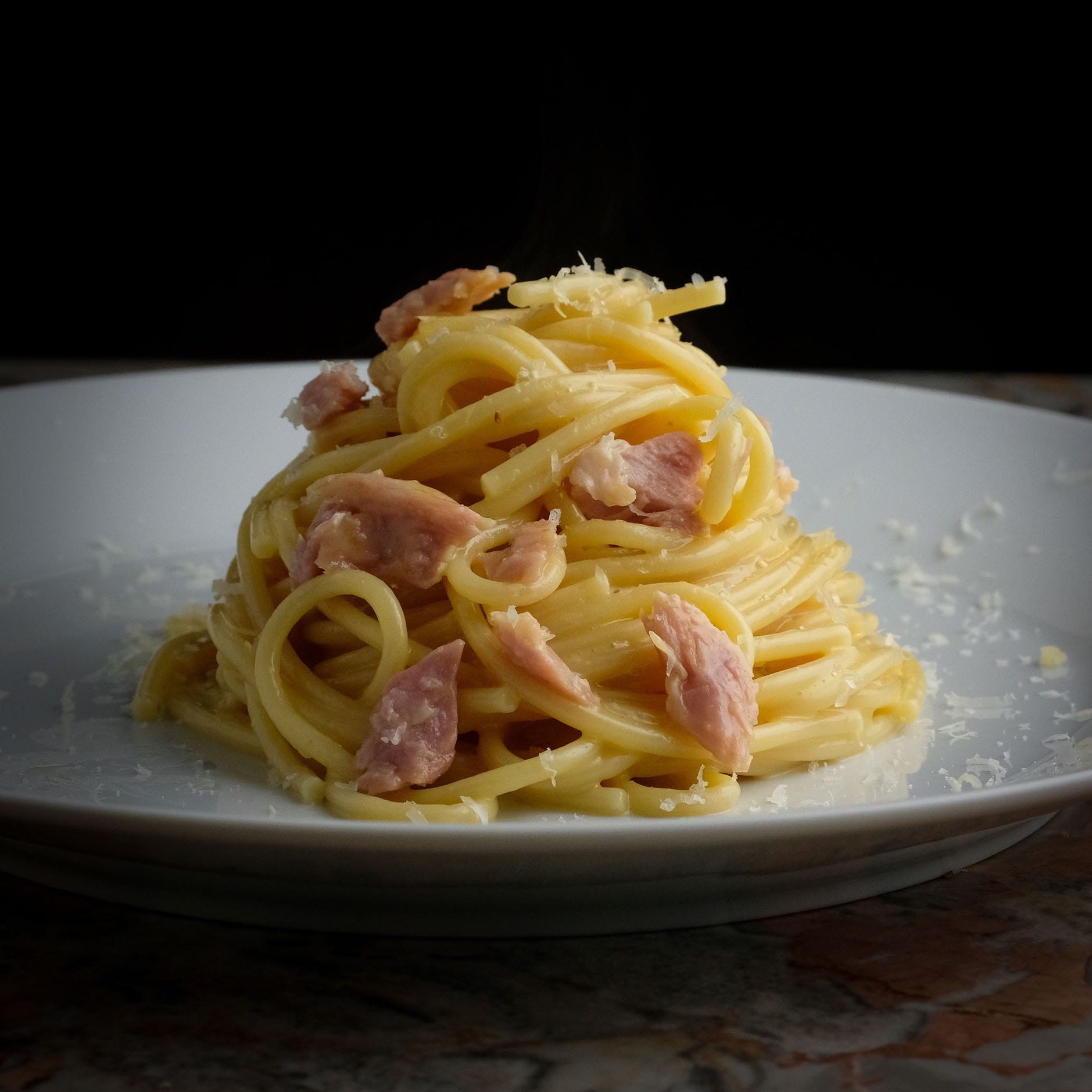
Ham, eggs and pasta. Today of course you’d be forgiven for thinking it ordinary, but consider for a moment the impact Theodora’s Carbonara might have had back then. That’s quite hard for us to do. But imagine, a pasta sauce without a tomato in sight; in their place, a buttery sauce made with ham and eggs. Unknowingly, perhaps, Theodora was exploring a genuinely undiscovered country.
FIRST IMPRESSIONS
We might call it an indulgent recipe, in a way; a fairly restrained way… but I think it would have absolutely been seen as an indulgent recipe in early 50s Britain.
We might say it’s a recipe with a certain air of refinement and class, but perhaps think it doesn't amaze.
But I think even today it’s a recipe that knows it doesn’t need to try too hard. It can whisper its credentials in a confident, matter-of-fact way and know you’ll always remember its roots; the taste of a very different pasta and a very different Britain.
When you try it, and I hope you do, just let Theodora’s Carbonara take you back to the Britain of the 1950s.
I promise you everything about this understated pasta will suddenly make sense.

You can see where Theodora FitzGibbon’s Carbonara sits in the historical carbonara recipes by clicking the diagram above, in the ‘Team Eggs’ segment.
the recipe: how it eats, what it tells us
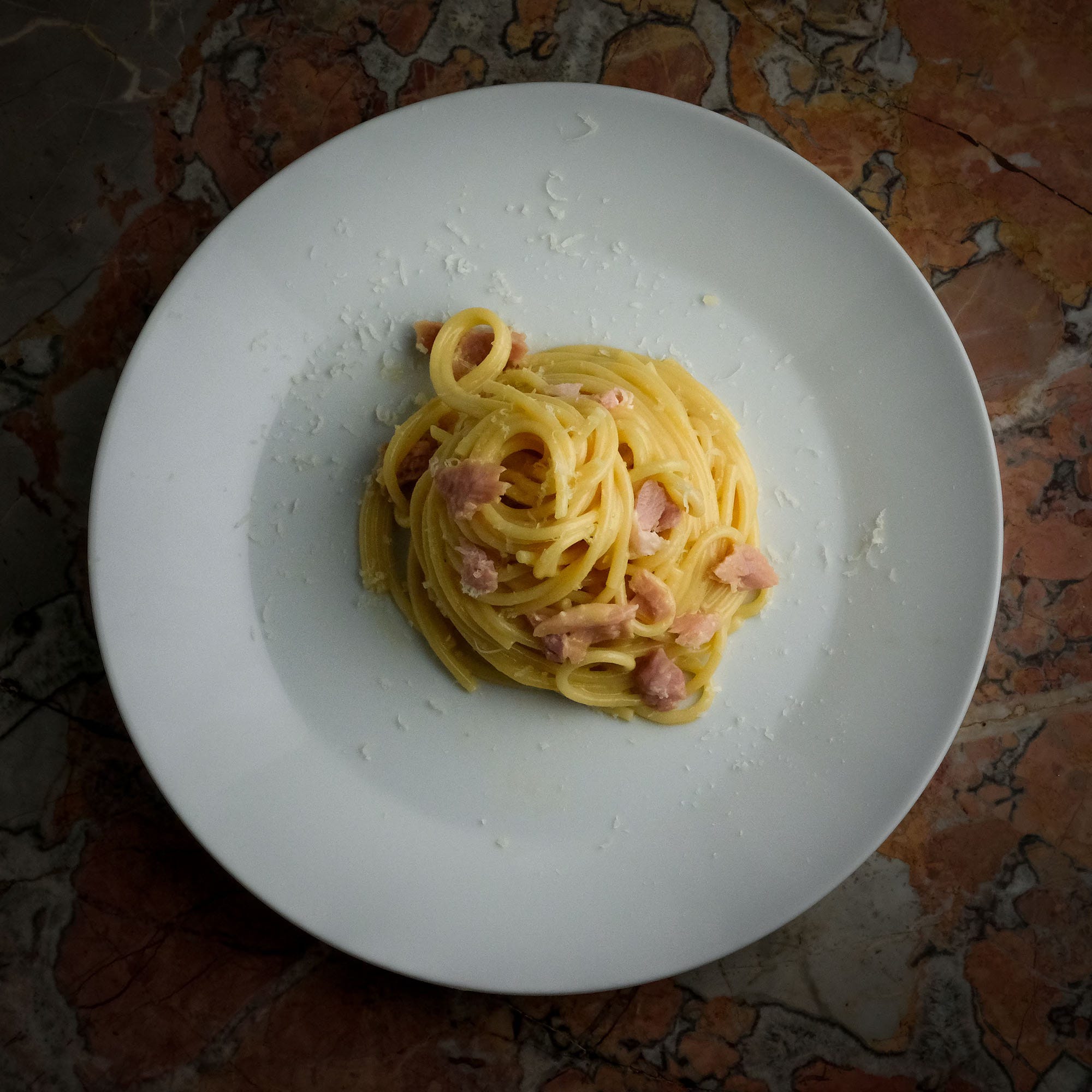
We’re so used to seeing crispy pig on Carbonara that Theodora’s Carbonara looks, with its pale pink ham and minimalist appearance… a little under-done and unfinished.
However, a couple of huge things to consider here.
IT’S THE VERY FIRST BRITISH CARBONARA
First, take a look at the diagram above. We’re very early on in the timeline of published Carbonara recipes - excluding the Liberation Carbonara of 1944, which never appeared in print at the time, Theodora’s is one of the three earliest Carbonara recipes ever published - along with the Fabrizi Carbonara (Croix du Nord, 20/4/1952) and the Chicago Carbonara (Vittles & Vice, Patricia Bronté, 12/1952).
However, Theodora’s was almost certainly the first Carbonara recipe that British home cooks would have encountered. Italian actor Aldo Fabrizi’s recipe had appeared in a regional French newspaper, while Patricia Bronté’s was buried in a Chicago restaurant guide published only in December 1952. Theodora’s book also went on to be reprinted in 1953 and again in 1960, meaning it carried considerable influence for the way Carbonara was cooked in Britain at that time, even allowing for variations like Elizabeth David’s Carbonara.
PEPPER: IS THIS RECIPE ‘CARBONARA’ BEFORE THE ‘COAL’?
A second consideration. Look at the ingredients of the first five ‘Team Eggs’ Carbonaras. Fabrizi likes pepper, as does Cucina Italiana - but British and American cooks aren’t even told that back pepper is a main ingredient of the sauce. That’s potentially at odds with the theory of the recipe’s name deriving from the charcoal burners of central Italy (i.e. that pepper is a representation of charcoal). Subsequent recipes in the 1960s and later fluctuate between including and omitting black pepper - which begs the question, when and why did Carbonara first acquire its ‘carbone’ ?
We currently have no information about the ingredients of the Trastevere Carbonara of 1939, which is the first recipe we know of called ‘Carbonara.’ It may or may not have contained pepper. However, our ‘mitochondrial Eve’ recipe, Strascinati of 1931, DID include pepper, as did the two dishes I see as contributing to Carbonara’s original emergence: Cacio e Ova and Pasta alla Gricia. Both of these related recipes included pepper… so the mystery of why Theodora chose to omit the spice from her recipe remains.
FOOD RATIONING
NB I’ve reproduced the original ingredients below, together with my tweaks. Cooking the recipe as published delivers a pretty dry and austere result, which is the tell-tale consequence of the author writing for the ingredient availability of the time: WW2 and rationing has ultimately delivered much more parsimonious ingredient quantities than we’re accustomed to today.
When I cooked the recipe a second time I increased the quantities of some of the ingredients, which I think may have been a more accurate recreation of whatever pasta Theodora originally ate in Rome.
In the introduction to her book, Theodora does say that when she returned to Britain—about three years before writing the book—she had heard alarming accounts of the ‘impossibility of surviving on the rations.
I think it’s clear that Theodora is taking pains to make readers aware that the recipes in the book have been written with many of the original ingredients substituted, to cater for what foods might be available in Britain - but that hasn’t deterred her from writing the recipes she wanted to write, in fact she says “…a good substitute is far superior to ignoring the recipe..”
Seen in that light, Theodora’s Spaghetti Carbonara appears to be a much more extravagant dish, needing not insignificant amounts of ham, butter, egg and two different cheeses.
And all of that, of course, presents the choice of cooked ham - along with Gruyére, as the ingredients most likely to have been substituted. Yes, there’s a chance that whatever Carbonara Teodora ate in Rome was made with Gruyére and parmesan, but I think it’s far more likely that those were the most practicable cheese and meat substitutes she could find.
Butter is a tricky ingredient to explain - it could have been chosen to make up for the missing fat from a fattier cut of pork, or it might have been simply an addition to raise the status of the dish.
Whatever the answers, I’d like to think that Theodora would have still been able to recognise her recipe in my interpretation here.
Spaghetti Carbonara, Theodora Fitzgibbon (1952)
FOR FOUR PEOPLE
original ingredients
340g / ¾ lb freshly made spaghetti
115g / 4oz cooked ham, chopped
2 egg yolks
15g / 1 tbsp butter
115g / 4oz Gruyère, grated
55–60g / 2oz Parmesan, grated
my tweaks
400g dry spaghetti
140g / 5oz cooked ham on the bone, torn
4 egg yolks
30g / 2 tbsp butter
120g / 4¼ oz Gruyère, grated
60g / 2oz Parmesan, grated
method
Theodora’s original method is:
Boil the spaghetti for 20 minutes. Melt the butter, chopped ham and Gruyére cheese until the cheese becomes sticky. Add the Parmesan and mix in the egg yolks, but do not allow them to cook. Mix this sauce well into the spaghetti and serve at once.
And let me confess there are a few ‘period’ touches there that I simply can’t bring myself to adopt.
First, boiling the pasta for 20 minutes - I just can’t. My spaghetti were cooked to a slightly chewy, ‘al dente.’ Secondly, I have to confess to preferring to mix both cheeses with the yolks and whisk them together before adding to the cooked pasta - this is clearly a more modern technique but I think it guarantees a result closer to what Theodora’s written - that we shouldn’t allow the eggs to cook at all.
Lastly, notice that Theodora wants us to ‘melt the butter, chopped ham and Gruyére’ together; my interpretation of that is that the cooked ham shouldn’t be crisped or coloured at all.
Here’s my revised method, which I think brings Theodora’s 1952 Carbonara straight to your plate.
prepare the ingredients
Grate the cheese, tear the ham, separate the yolks.
boil the pasta
Boil the pasta and when it’s half done, melt the butter in a tossing pan and being to warm the ham gently.
make the ‘sauce’
Whisk the cheese and yolks together.
toss and combine
When the pasta’s very nearly done to your liking, fish it out of the boiling pan and add to the ham and butter in the tossing pan, with perhaps a tiny splash of cooking water. Mix, toss, and then let the spaghetti rest for a minute or two, so that the temperature drops slightly and you’re less likely to make scrambled eggs when you…
Add the egg mixture to the pasta, toss, add small amounts of cooking water if it needs to loosen up, then plate and serve immediately.
HUGE THANKS go to Luca Cesari for his discovery of Theodora FitzGibbon’s Carbonara while researching food history in London in Summer 2026 - Luca, you discovered the ‘missing link’ in the evolution of British Carbonara! A grateful nation salutes you!
give me the next Carbonara
https://jackycooksherbooks.substack.com/p/theodora-fitzgibbon?r=68jc6&utm_medium=ios
I could email you numerous newspaper advertisements for olive oil throughput the decades of the 20th century … including mail order services. The author of Acetaria .. a discourse on salads, John Evelyn was recommending the best oil from Lucca as early as 17c . There is a long history of olive oil, albeit some times other oils used for salad…