


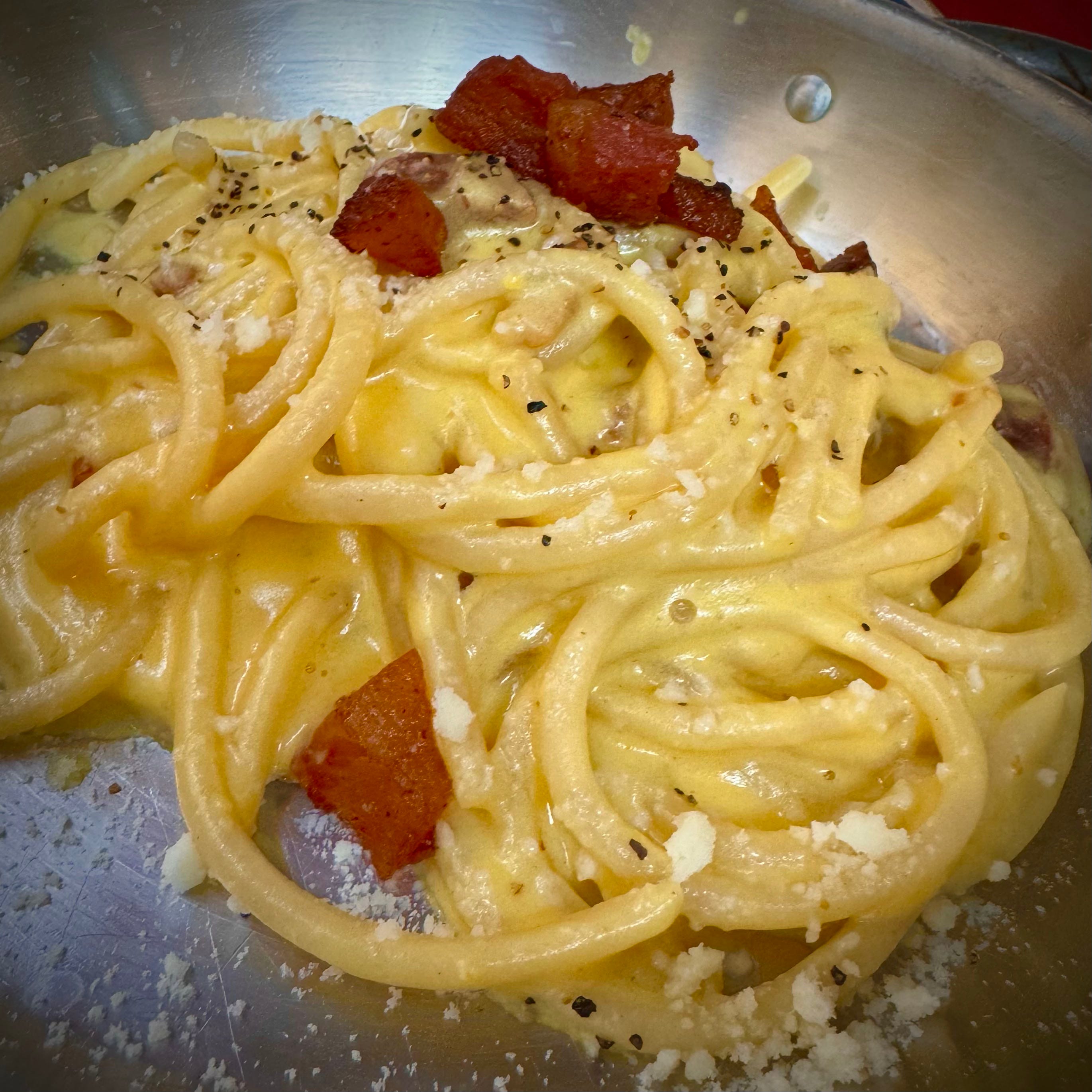
I don’t even like Carbonara that much, yet here I am, trying to make sense of the original shape-shifting pasta—and from a decidedly British point of view too. I want to work out how we started cooking Carbonara in Britain in so many different ways, following the recipes back as far as we can to uncover when—or if, or perhaps why—we started cooking pasta with eggs and cheese and pig our own way.
I want to go in search of Authentically British Carbonara.
“…Well, we know where we're goin'
But we don't know where we've been
And we know what we're knowin'
But we can't say what we've seen…”
‘Road to Nowhere,’ Talking Heads, 1985
A Cunning Plan
I’m going to try something possibly quite foolish. I’m going to try and reconstruct Carbonara’s DNA by combining historical recipes, studies, my own research, recipe recreations and my own original recipes to figure out how we got to the Carbonaras we’re cooking today in Britain. But I think it might be fun too to try and guess where that road might be taking us.
I’m massively indebted to the work of, amongst others, Luca Cesari, Alberto Grandi, Janneke Vreugdenhil, Edwin Winkels and of course the original chefs, restaurants and recipe authors - all of whom have inspired me to try and join these Carbonara dots.
The Key Recipes… and Ingredients
Let’s dive in and get controversial straight away.
Over the course of this miniseries I’m going to be recreating some of the most significant recorded recipes for Carbonara. And to help me do that, I’ve made a little diagram - which you can see full-size by clicking the link or graphic below.
You can see in the diagram below that I’ve chosen a single recipe, Touring Club Italiano’s Strascinati from 1931, to be—in genetic terms—Carbonara’s ‘Mitochondrial Eve’: the earliest documented dish I’ve found that brings together so much of Carbonara’s ingredient DNA. Two possible contributing lineages, represented by the circled recipes for Cacio e Ova and Pasta alla Gricia, converge on Strascinati at the centre.
Now, in the interests of inclusivity, if you prefer your analogies cosmological, think of those two recipes as primordial elements feeding into the ‘Initial Singularity’ of Strascinati. Think Big Bang, the beginnings of the universe and that kind of stuff. Once those elements come together, the diagram shows the Carbonara Universe expanding outwards.
I think that’s quite clever… Click the graphic for the zoomable diagram.

And I can hear the teeth-sucking already. No, the 1931 recipe isn’t called ‘Carbonara’ and yes, it contains ingredients that aren’t regarded as canonical in Contemporary Carbonara. I’m not claiming that every subsequent carbonara descends from 1931 Strascinati, but it is the earliest documented dish we’ve found that brings together so much of Carbonara’s later ingredients.
That’s the kind of fun we’re going to be having in this series, together with history and theories and of course recipe recreations.
I’m excited. I hope you are too.
Fantastic Mark , your always soooo inspiring and insightful, your knowledge is pretty amazing 👏👏👏
Fascinating!