


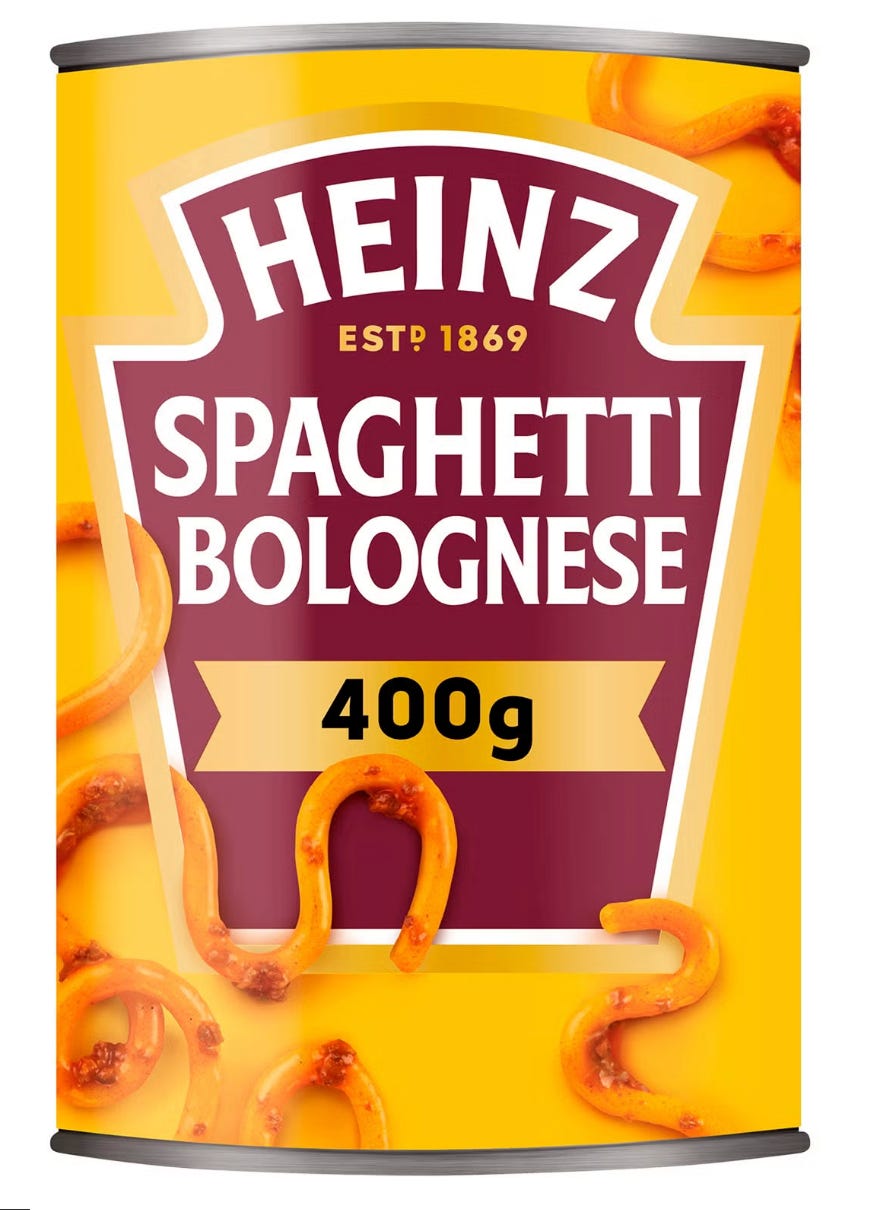
Long before 'Spag Bol' was considered a pillar of British family food, advertisers were selling two main pasta products. Dry pasta for cooks to prepare at home and ready cooked tinned pasta. Those last 4 words probably sound as terrifying to you as they do to me. However the history of how these early convenience products were marketed gives us a fascinating insight into how pasta spread outside Italy and how Britain and America rapidly adopted it as their own food.
In the early years of the 20th century, dry pasta was almost certainly consumed in greater quantities than tinned pasta. Tinned pasta, however, may have had a greater effect on consumers' knowledge and a stronger influence on how pasta became integrated in American and British cuisine.
From an advertiser's point of view, packets of dried pasta were a relatively easy product to market.
Advertising ready-cooked spaghetti, on the other hand, meant that you had to explain the concept of an entire meal in the product's advertising. What it was, what it tasted like, why anyone should want to buy it. I find it fascinating to see how the process of educating the market for pasta developed over the decades, through recipes, serving suggestions and in the case of Heinz, endlessly repeated combinations of tomato, cheese, meat, eggs and bacon.
And from that we can see that early convenience-pasta advertising did much more than sell pasta. It taught non-Italian consumers how pasta could be combined with meals and ingredients they were already familiar with. It made it much easier for homecooks to find the confidence to try the product and experiment with it. It was a perfect way to get to know a new, exciting and exotic food.
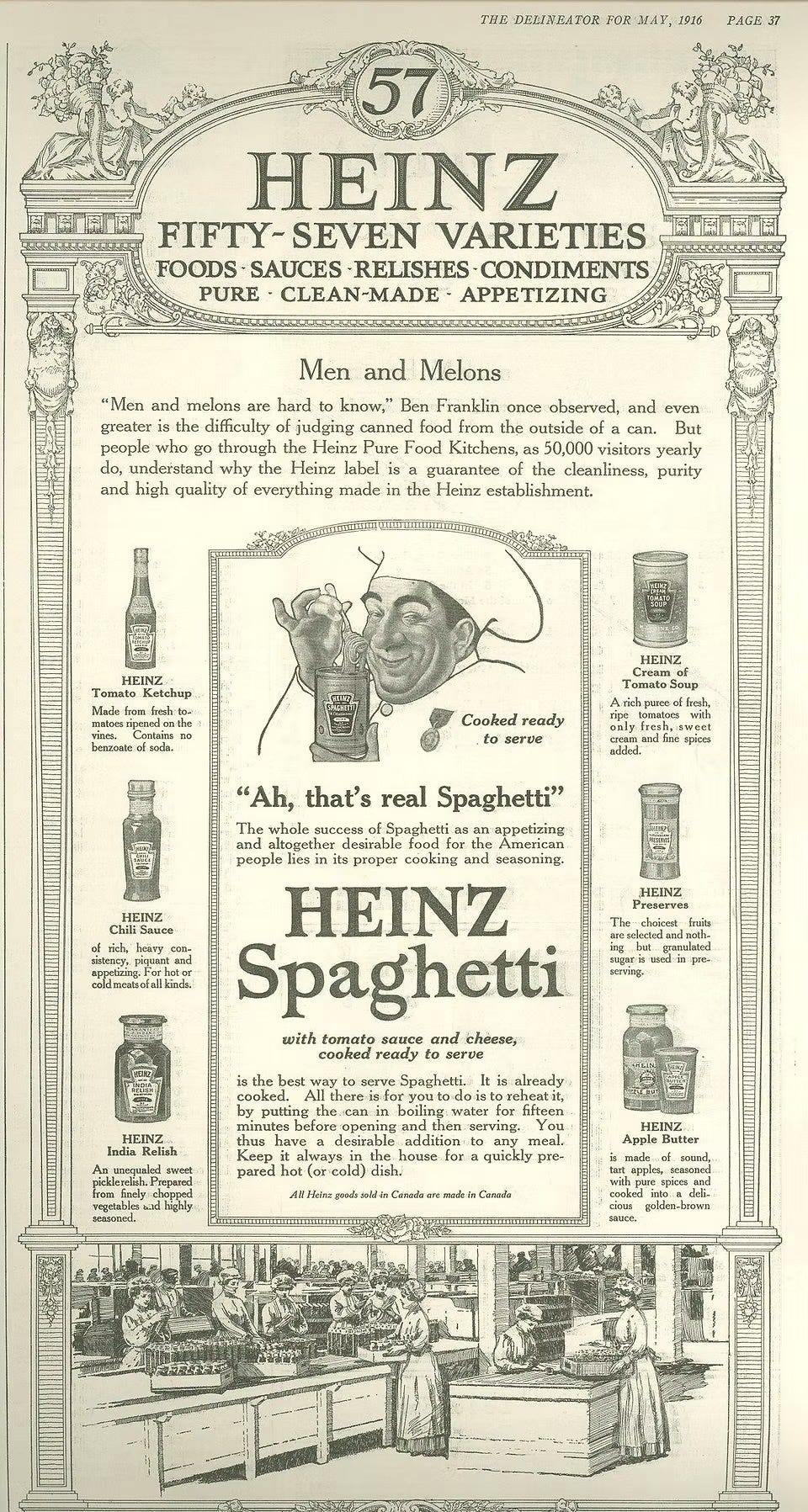
This 1916 Heinz ad is stuffed full of wonderfully 'period' copywriting... but to modern eyes looks like a confusing mix of product and brand awareness. From a period art direction point of view, it's fascinating.. An architectural border that evokes a Victorian exhibition or pavillion but typography and illustration in the central section that wouldn't look dated for perhaps 30 years. Heinz was selling a bold new concept in convenience food and needed the style of its advertising to mirror that.
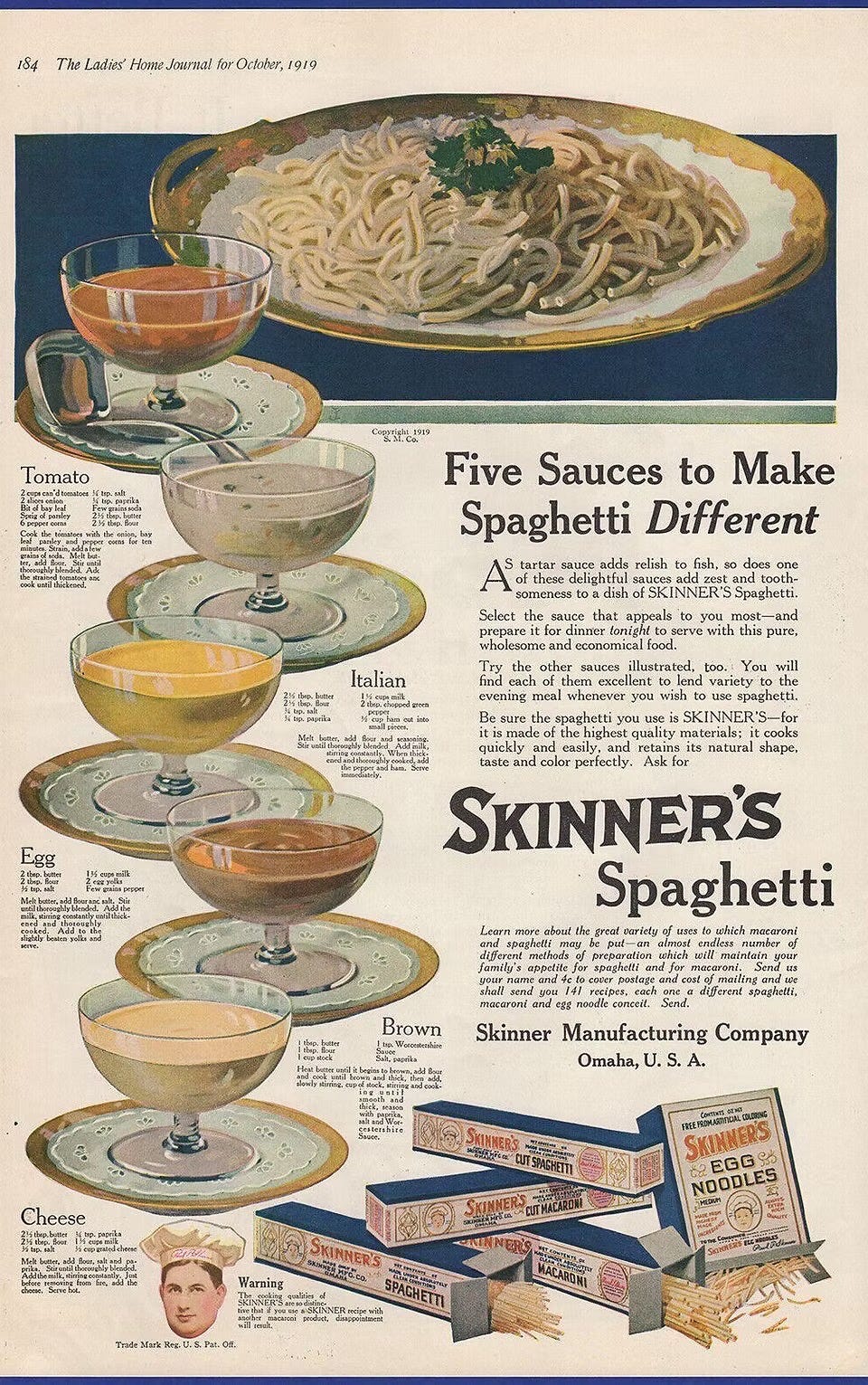
Another US ad which is heavy on education, Skinner's dry spaghetti from 1919. At first glance it's betraying some possible market resarch pointing to consumers seeing pasta as a pretty limited cooking option: "Five Sauces to Make Spaghetti Different."
This is a genuinely creative approach to selling pasta to a non-Italian market and's a tragedy that 'toothsomeness' hasn't survived in our modern pasta advertising and I honestly wish that I could get hold of the booklet of '141 recipes, each one a different spaghetti, macaroni and egg noodle conceit.' The sauce recipes themselves clearly borrow more than a little from French cuisine but the most remarkable detail is that he “Italian” sauce was not tomato-based but a milk-based white sauce with green pepper and diced ham!
Comparing Skinner's advertising to Italian press ads of the same time reveals something else. Italian brands seem to take the view that they don't need to teach consumers how to cook pasta, concentrating, instead on product awareness, and brand 'unique selling points' in quality, manufacturing, packaging and so on.
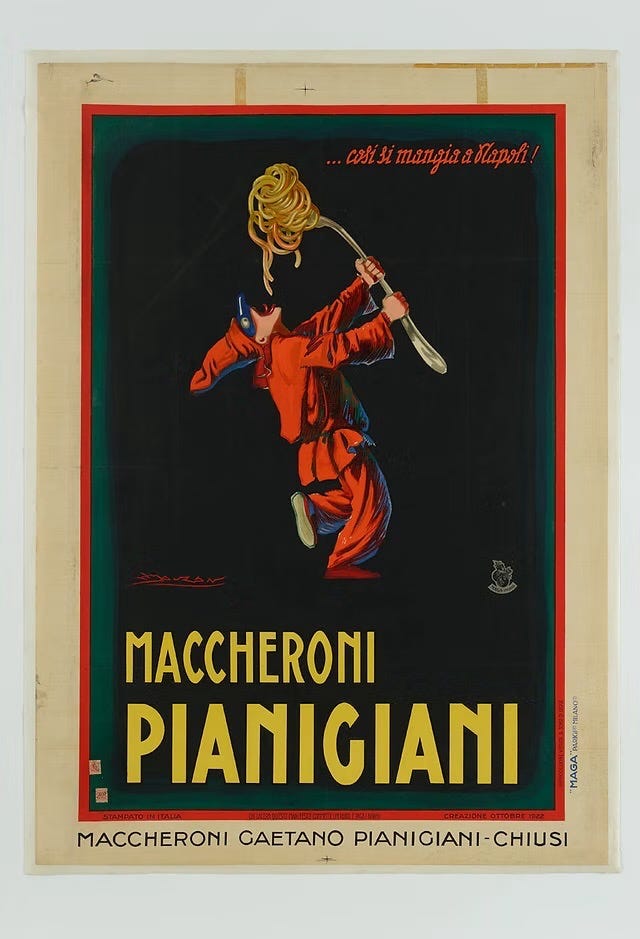
The Pianigiani 1922 poster above is a much more refined and evolved than the previous examples above, and again it's an example of a type of advertising quite a few years ahead of its time - in fact to me it already looks like mature, modern brand advertising. No recipes, or serving suggestions, just an assumption that consumers will instantly identify with the poster's theme, the character of 'Pulcinella,' from the traditional 16th century Italian popular theatre known as 'Commedia dell'Arte.'
British audiences would come to know the same anarchic rogue in street performances; first as 'Punchinello' and then later as 'Mr Punch' in 'Punch and Judy' shows. Curiously, while British Mr Punch's character is driven by violence, Pulcinella's driving force is hunger : Italian Commedia dell'Arte shows would often feature a stock gag of the always desperately hungry Pulcinella continuously stuffing his face with huge handfuls of macaroni.
And that's exactly what we've got in the Pianigiani poster - an abstract but instantly recognisable visual reference to Pulcinella, combined with more than just a tinge of Mr Punch - 'that's how we eat [how we do it] in Naples!'
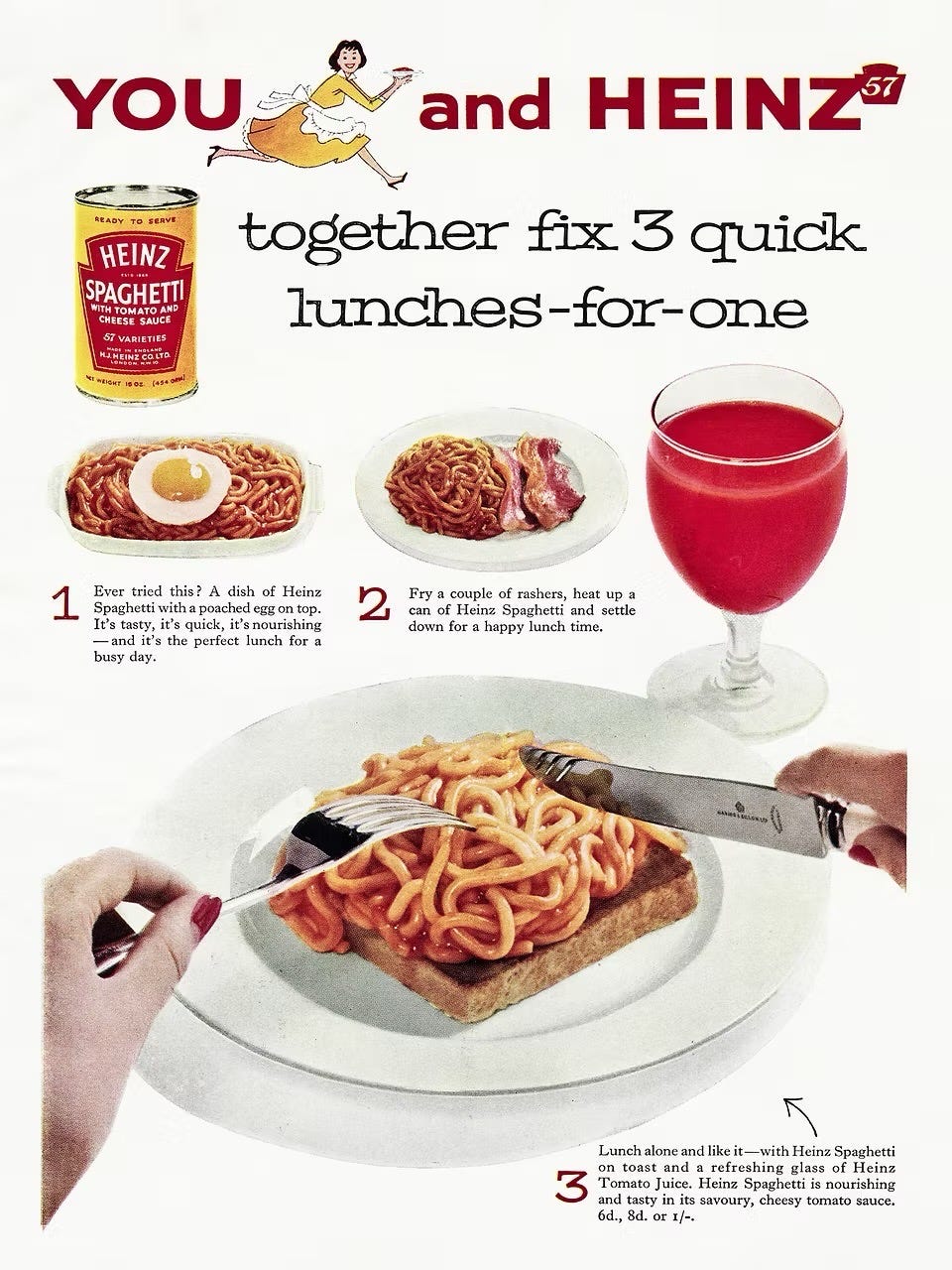
Nearly 40 years later in the UK , however, and we find only a few changes in this press ad from 1958-59. Heinz is still taking an educative approach but notice that they've finally moved on from having to explain what spaghetti in a tin is. There are clues to how they're going to be positioning their product over the coming years too. The graphics and headline explicitly address younger female consumers with recipe suggestions that are clearly quick, easy meals for one. A fried egg on a bowl of tinned spagheti is 'a nourishing and perfect lunch for a busy day' and the main image obviously substitutes baked beans for tinned spaghetti on toast. Heinz almost doesn't need to add supporting copy here - beans on toast had been popular UK convenience food for nearly 20 years by this time, though I get a sense that advertisers are still feeling like they need to fight against the social stigma of convenience foods.
That's just a small part of the history of how pasta spread through American and British kitchens - but the changing food habits and social trends they reflect are enormous. And they're part of the reason your kids love Spag Bol today.