IN THIS ARTICLE:
Butter - A sign of the times
When we think we’re always right
Thinking like a chef
When chefs went cheffy - and then got nasty
In Part 4 of Authentically British Carbonara I gave you the recipe for Spaghetti alla Carbonara di Santa Maria in Trastevere, from ‘With Gust and Relish,’ written in 195y by Lord Westbury and Donald Downes. It’s a dish that’s made me look back at some of the other early 1950s recipes we have for Carbonara, and it’s made me notice something quite startling.

BUTTER - A SIGN OF THE TIMES
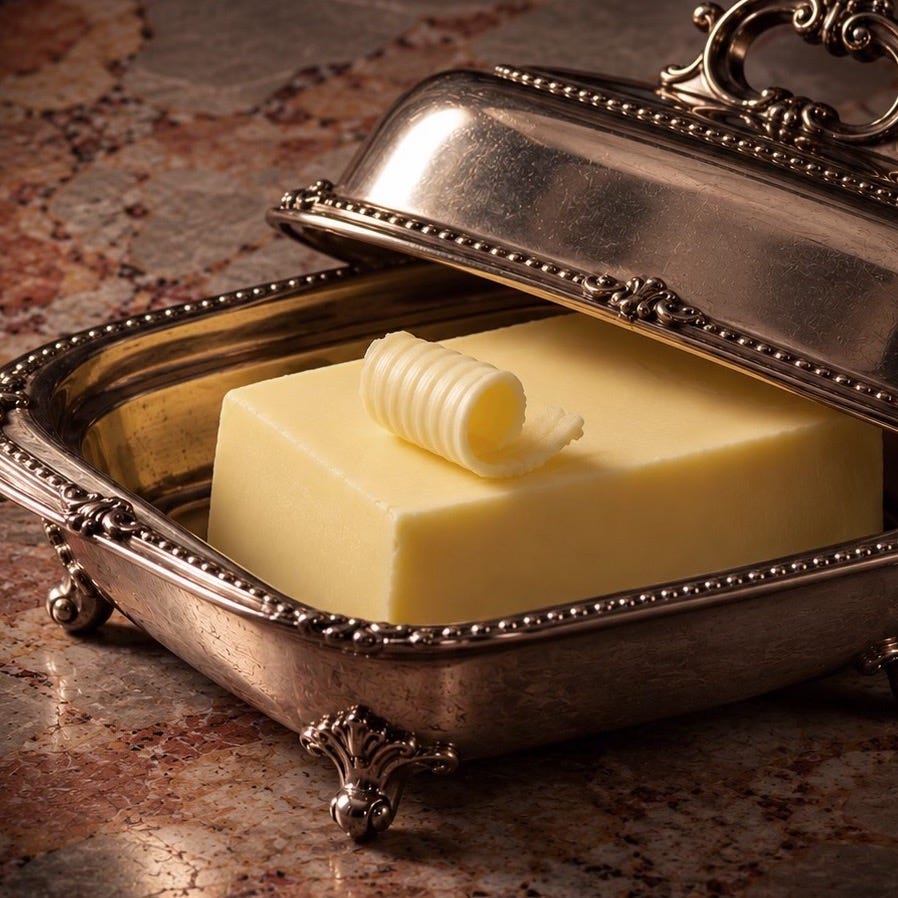
Take a close look at the ingredients listed for the 1950s Carbonara recipes in the diagram above. Notice how many of those early variations list butter as an ingredient, with Italian writers alongside British and American. You’ll probably be aware that nowadays the guanciale-pecorino-yolks-pepper mantra reigns supreme; alongside cream, putting butter in your carbonara puts you firmly in cancellation territory. But back in the 1950s, it seems almost as if there there was a real developing tradition of including in Spaghetti alla Carbonara as many dairy fats as you could lay your hands on!
I wondered if this might be if not a smoking gun, then perhaps a suspiciously steaming plate of Carbonara. A plate of Carbonara based on a butter and cheese sauce. After all, Fettuccine all’Alfredo had been a Roman recipe sensation for a good couple of decades by the outbreak of WW2, and we don’t have - as yet - confirmation of the ingredients in the Carbonara that Nora Koch wrote about in 1939. How hard would it have been for someone to simply add pancetta or guanciale to buttery, cheesy Alfredo and come up with the first Carbonara? The same recipe would probably have surfaced again in the post war years, as soon as rationing and the economy allowed the return of bums on trattoria seats. Exactly, in fact, as the diagram above seems to show.
Has one of Carbonara’s ancestors being hiding in plain sight for a hundred years?
WHEN WE THINK WE’RE ALWAYS RIGHT
Then I stopped and thought. Several times. Because I was reminded of the many times I’ve noticed that irritating and appalling trend in modern food writing. The one where we snigger and scoff and pick holes in old recipes or techniques. Butter or cream in Carbonara? ‘Clearly didn’t know what they were doing… making it up as they went along…’ and so on. And that’s terrible. It’s as if we’ve come to happily accept a kind of default attitude - where our modern, codified versions of recipes are assumed to be the correct, ‘authentic’ versions of those dishes.
Even worse, many of these ‘genuine’ recipes are wrapped up in retrospective and, frankly, completely made-up folklore. With Spaghetti alla Puttanesca it’s the brothels of Naples; with Cacio e Pepe we’re asked to believe in the original galloping gourmets, the shepherds of anywhere from Lazio to Molise to Puglia (depending on who’s telling you the story) who tended their flocks accompanied by a trusty rucksack stuffed with a cooking pot and all their pasta-ready ingredients. With Carbonara, we’re told either the dish was conjured up out of American Army rations for a top-brass banquet, or that it caught on thanks to those same rations being available on the black market in Rome, because the GIs missed their ham and eggs so much! (Unfortunately for those two theories, we know have proof that the name Carbonara was well-known in Rome at least four years before the Allies got anywhere near the Eternal City!).
All these recipes - and there are many more - do have one truth in common. They’re all ‘presented-as-traditional’ dishes whose origin stories we’ve come to desperately want to believe. A cosy and comforting ‘golden age’ where the cicadas chirp 24-7 in the olive groves and the whole family plus dog, cats and chickens sit down together to eat their cucina povera greatest hits, in front of a backdrop of the rolling hills of Tuscany or the Amalfi Coast.
In reality, the majority of these back-stories have little to do with the likely origins of the pasta dishes they involve; yet still they remain endlessly repeated online and in cookbooks; lazy people telling stories that are easy to remember.
…there’s a temptation to look back at the cooks of the past
and think that we’re the ones who know it all…
And so it’s no surprise that there’s a real temptation to look back at the cooks of the past and think that when it comes to getting the ingredients and the techniques right, again we’re the ones who know it all. It’s easy to dismiss butter (and later cream) in Carbonara as either a feel-good ingredient that found its way into the recipe after years of wartime food rationing, or simply a crass and extravagant 1950s food fad, included as part of the ‘Frenchification’ of Italian cuisine.
The reality, I think, could be a little more nuanced. And in the case of butter, it could be entirely due to how the ingredients and the cooking techniques of Carbonara evolved.
THINKING LIKE A CHEF
And so, as much as I love a conspiracy theory, I conceded reluctantly that there might actually be another reason for the butter mountain of Trastevere. The answer came when I started thinking like a chef. Or perhaps a home cook with fading cheffy aspirations.
Here’s the fundamental problem. Despite its apparently simple list of ingredients, it’s not that easy to cook an edible, credible Carbonara - it needs to be safe to eat, look good, and be delicious too. (The first time you make it, you’ll probably make scrambled eggs - as I did.) But I think if we look at the issues the writers and cooks were facing when they tried to make those early Carbonaras, it’s pretty easy to deduce the reasons for choosing the ingredients they did.
…the pork in many early Carbonaras simply wasn’t fatty enough
to make the sauce we expect today…
Have another look at the Carbonara diagram above. The vast majority of those recipes rely on cuts of pork like pancetta, coppa or bacon - cuts of pork that aren’t guaranteed to deliver lots of rich, rendered fat. And loads of fatty lipids is exactly what a ‘minimalist’ sauce like Carbonara needs - to be able to create the right balance of fat and water and make the perfect emulsion of egg, cheese and pasta water to coat the pasta.
So let’s put ourselves in the position of a 1950s Roman cook, or chef … or a 1950s food writer. Our available pig isn’t the fatty modern choice, guanciale - and that’s a fairly significant problem, because we need enough fat in the recipe to be able to make a silky and delicious egg and cheese based sauce.
I think that’s the main reason why so many of those early recipes included butter, and often also, oil too. They weren’t trying to be French, or create a rich and opulent sauce just for the sake of it. They were simply trying to make enough of a sauce in a consistency that would cover the pasta!
WHEN CHEFS WENT CHEFFY AND THEN GOT NASTY
Decades passed and cream joined butter in the stable of dairy fats in Carbonara. And then gradually, some time around the late 1990s, overtly buttery and creamy Carbonaras, along with shoulder pads and big perms, began to fall out of fashion. This coincided with a gradual paring down of ingredients lists - superfluous mushrooms, garlic, onion and parsley all fell by the wayside as a purer, simpler Carbonara taste surfaced. It tasted of history, an imagined cucina povera staple which became the star of a new narrative: Carbonara’s always been that way - just four simple rustic ingredients.
The fabricated myths began to be recirculated, first offline and then, with the birth of social media, online too. In 2010 Instagram joined YouTube and Facebook and transmission rates for the new Carbonara myths (along with a reinforcement of other origin stories, like that relating to the 1944 Liberation of Rome / Army Rations Carbonara) increased exponentially.
And that’s when chefs went cheffy. And then got nasty.
Even as late as 1999, it might have been perfectly respectable to throw a knob of butter or a tablespoon or three of cream into a Carbonara - but barely a decade later Italian cooking appeared to have descended into chaos. In 2008 the Accademia Italiana della Cucina proclaimed butter to be amongst Carbonara’s ‘infamies,’ whilst at the same time declaring a carbonara made with garlic, olive oil that mixed Parmesan and Pecorino was the “true recipe.”
…It didn’t matter that Carbonara looked like spaghetti
dressed in a gallon of custard with cheeky chunks
of crispy cheeky bacon - in fact, that was the point…
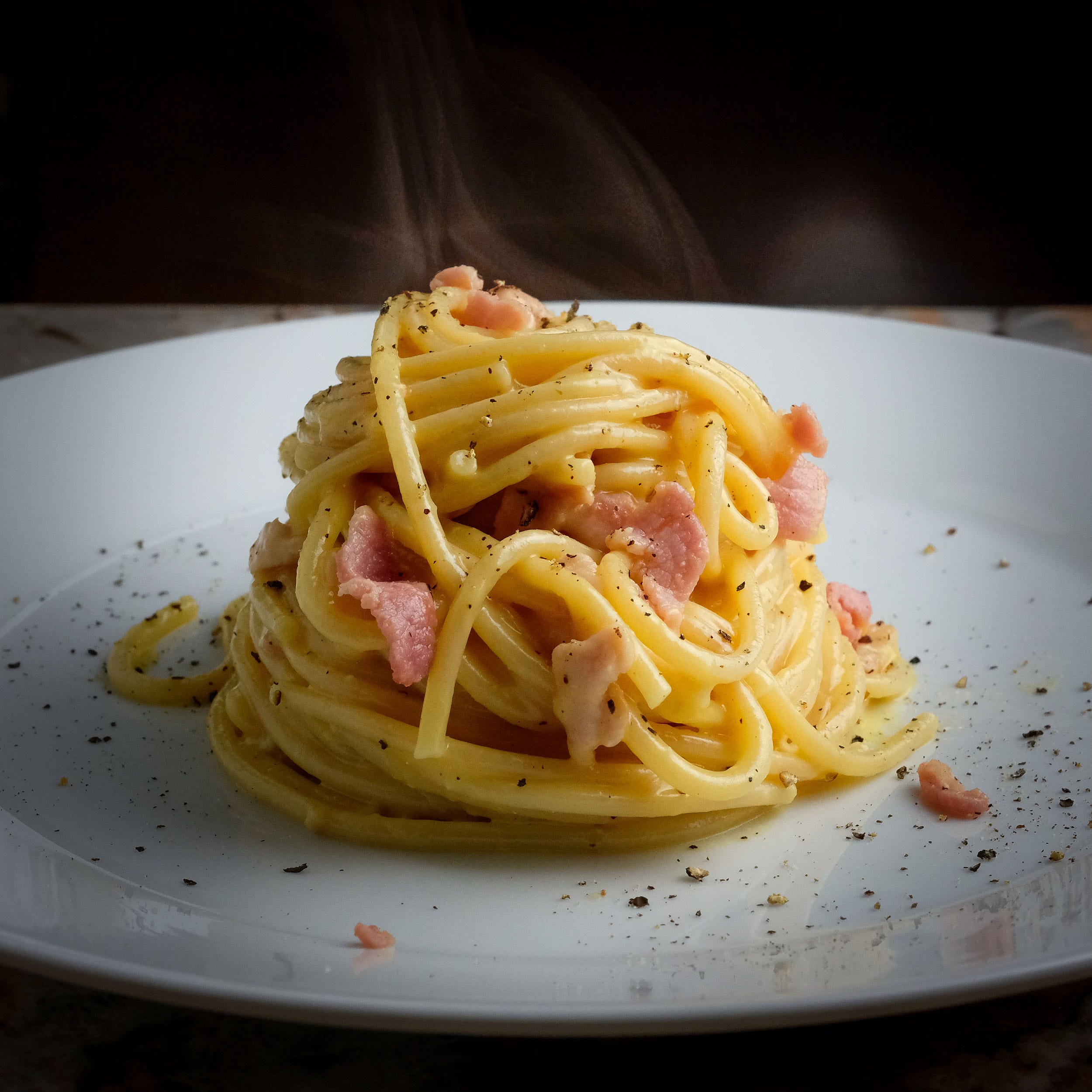
So suddenly, Carbonara was very, very different. Butter, cream and extra oil were out and rendered guanciale fat was in. This was a dish that needed to look good on social media; over-the-top, extravagant, visually stunning. It didn’t matter that it looked like spaghetti dressed in a gallon of custard with cheeky chunks of cheeky crispy bacon - in fact, that was the point. More was definitely more.
And that’s how Carbonara became the poster child for a brand new concept: ‘Food Porn.’
Some time around 2012 ‘Carbo-crema’ arrived, along with a precisely codified - and exceedingly tricky - cooking technique. Which of course was, yet again, a godsend for social media. Imagine a pasta that everyone loves but is just a little bit difficult to get right. Ideally sidestep salmonella but also avoid making an omelette. Unboxing videos, make-up tutorials and even kittens were now going to have to make way for what looked like several decades of Carbonara How-tos to come as we wrestled with bain-maries, adding extra cooking water and many other ‘tips for the perfect Carbonara.’
But let’s backtrack a moment, because the one aspect of all of that which I find fascinating but also incredibly hard to believe is that in the space of just a few years, ingredients can go from accepted and not being given a second thought to ‘disgusting’ and completely ostracised. It’s a phenomenon that I really struggle to explain. But then maybe we really are just that fickle.
Today, nearly fifteen year later, I get the impression little has changed, with the exception perhaps that the last 18 months or so have seen a handful of ‘influencers’ actually recreating ‘old school’ Carbonaras. And it’s been fascinating to watch the keyboard battles. Millions and billions of pixels on tiny screens forming the expected clichés: “Well that’s not real Carbonara then!’ …. ‘Eewwwww disgusting!’ ….‘My Nonna never made Carbonara with Pancetta!’… ‘Well my dog’s a rescue dog from Rome and he ALWAYS eats Carbonara with cream,’ and so on…
But now what? I’m not taking bets. Maybe ‘Custardnara’ has become just too embedded to be toppled. Maybe a new sense of history will prevail.
Or maybe there’s a new ‘old’ pasta waiting in the wings, just itching to be Carbonazzled.
NEXT WEEK… my research uncovers a contemporary mention of the Roman restaurant linked to the earliest known mention of Spaghetti alla Carbonara … from 1937.